
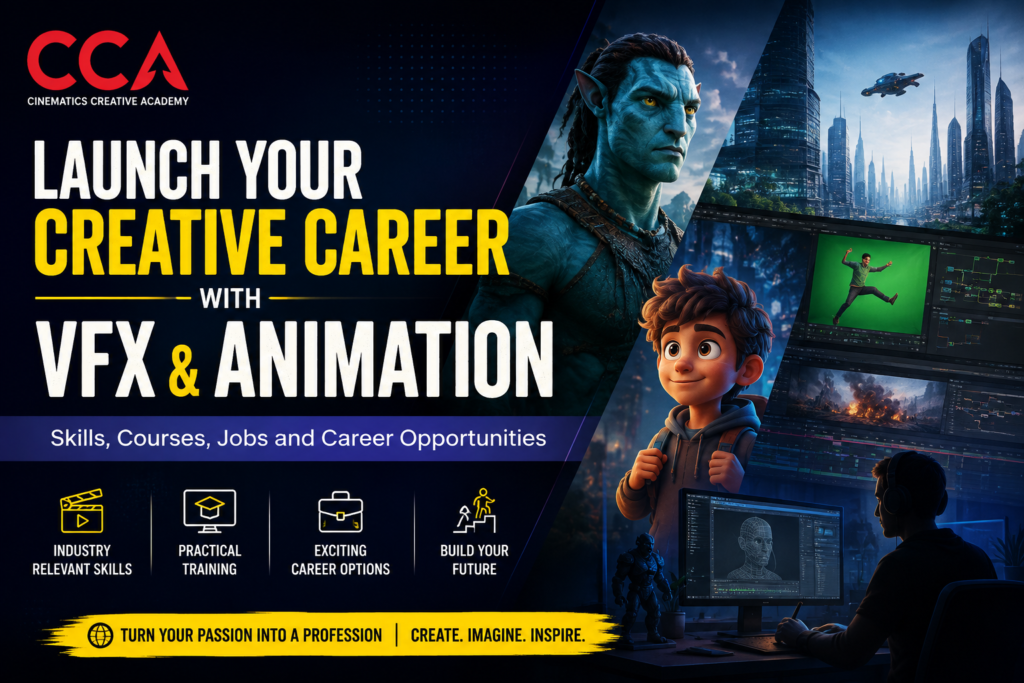
The entertainment and digital-media industry is becoming increasingly visual. Movies, streaming content, advertisements, games, music videos, social media campaigns and branded content all rely on digital artists to create experiences that capture attention. Behind many of the scenes audiences see today are professionals working with animation, CGI, compositing, 3D design and visual effects.
Cinematics Creative Academy is a creative education institute focused on helping students explore animation, VFX, 3D design and other digital-media disciplines. For students considering a creative career after 10th, 12th or graduation, structured training can provide an opportunity to understand different specialisations, develop technical abilities and create practical projects.
If you have ever been interested in creating digital characters, cinematic environments, animated stories, game assets or impressive visual effects, the animation and VFX industry offers several directions worth exploring. However, starting a career requires more than simply learning software. You need creativity, technical knowledge, practical experience and a portfolio that demonstrates what you can actually create.
What Do Animation and VFX Professionals Actually Do?
Animation and visual effects are often grouped together, but they involve different creative processes.
Animation is primarily concerned with creating movement. Artists can animate characters, objects, graphics and environments to communicate actions, emotions and stories.
Visual effects, commonly called VFX, involve creating, modifying or combining visual elements to produce images that may not be practical to capture directly during filming.
A single production may use several disciplines together. A scene could begin with live-action footage, incorporate a digitally created environment, add a 3D character, introduce simulated effects and finally combine everything through compositing.
This is why the industry requires professionals with different areas of expertise.
Why Is VFX and Animation Becoming a Popular Career Choice?
Visual content is now part of almost every major form of digital communication.
Consider how often you encounter:
- Animated advertisements
- CGI characters
- Visual effects in films
- Motion graphics on social media
- 3D product presentations
- Game environments
- YouTube animations
- Explainer videos
- Digital campaigns
- Virtual production
For creative students, this provides an opportunity to turn an interest in visual storytelling into a specialised career.
Students who enjoy photography, video editing, gaming, drawing, design, storytelling or experimenting with digital tools may find animation and VFX particularly interesting.
Can You Start VFX and Animation After 10th or 12th?
Yes, students can explore creative-media education after completing their school education, although eligibility varies according to the institute and specific programme.
After 10th, students may consider foundation or diploma-oriented programmes where available. After 12th, they can explore more specialised courses in animation, VFX, 3D, motion graphics, gaming and related areas.
Your academic stream does not automatically determine whether you can enter a creative field.
Students from science, commerce and arts backgrounds can develop careers in different areas of digital art and visual production. What often matters more is your willingness to learn, practise and develop your creative abilities.
What Can You Learn in a VFX and Animation Course?
The curriculum differs from one programme to another, but comprehensive training can introduce students to multiple stages of digital production.
3D Modelling
3D modelling involves constructing digital objects and environments.
Artists may create:
- Characters
- Buildings
- Vehicles
- Props
- Digital environments
- Product models
The objective is to create models that are visually appropriate and technically usable within a production workflow.
Texturing
Texturing gives digital models their visual surface characteristics.
A texture can communicate whether an object is made from:
- Metal
- Wood
- Glass
- Plastic
- Fabric
- Stone
- Skin
Understanding materials and surface details helps artists make digital objects appear convincing.
Lighting
Lighting influences the appearance and mood of a scene.
A well-designed lighting setup can make an environment feel dramatic, realistic, mysterious, bright or cinematic. Lighting is therefore an important part of both visual quality and storytelling.
3D Animation
3D animation brings digital characters and objects to life.
Students can learn concepts such as:
- Timing
- Posing
- Movement
- Weight
- Expressions
- Character acting
- Spatial awareness
Good animation is not simply about moving an object from one point to another. Movement should communicate intention and make the scene believable.
Compositing
Compositing is the process of combining different visual elements into one final image.
For example, a finished shot could contain live-action footage, a green-screen subject, a digital background, atmospheric effects and CGI elements.
The compositor’s job is to make these components appear as though they belong together.
Rotoscopy
Rotoscopy involves creating accurate selections or masks around subjects and objects in footage.
It can be used for removing backgrounds, isolating elements and supporting complex compositing work.
Motion Graphics
Motion graphics combine graphic design and animation.
They are widely used in:
- Advertising
- Social media content
- Corporate videos
- Brand campaigns
- Title sequences
- Presentations
- Explainer videos
This area can be particularly useful for designers interested in combining typography, graphics and movement.
Game Art
Students interested in gaming can explore the creation of digital assets such as characters, environments, props, textures and effects.
Which Software Is Used for VFX and Animation?
Different departments use different tools, so students should select software according to the area they want to pursue.
Depending on the programme and specialisation, learners may encounter tools for:
- 3D modelling
- Character animation
- Compositing
- Video editing
- Motion graphics
- Simulation
- Texturing
- Rendering
Software such as Maya, Blender, Adobe After Effects, Adobe Premiere Pro, Foundry Nuke and Houdini may be relevant to different parts of the production process.
However, software knowledge should not become the only focus of your education.
Knowing a tool is useful, but understanding why and how to use that tool creatively is what helps you develop professionally.
What Skills Are Needed for a Career in VFX and Animation?
Technical skills are only one part of becoming a successful digital artist.
Creativity
You should be able to generate ideas and find visual solutions rather than simply reproduce existing work.
Observation
Artists need to notice details in the real world, including lighting, textures, proportions, movement and facial expressions.
Attention to Detail
Small mistakes can affect the realism and quality of a final shot. Developing patience and accuracy is therefore important.
Storytelling
Visual effects and animation are ultimately communication tools. Understanding what the audience should see, feel or understand can improve your creative decisions.
Problem Solving
Production work often involves unexpected technical and creative challenges. The ability to analyse a problem and find an efficient solution is valuable.
Communication
Creative production is usually collaborative. Artists may receive feedback from directors, supervisors, designers, editors and other departments.
Continuous Learning
Technology and production methods continue to change. Professionals need to stay curious and update their skills throughout their careers.
How to Begin a Career in VFX
If visual effects interest you, you do not need to master every department at once.
Start by exploring different areas and identify what you enjoy most.
You might discover an interest in:
- Compositing
- Rotoscopy
- Match moving
- Matte painting
- 3D modelling
- Lighting
- Environment creation
- FX
- Digital compositing
Once you identify an area that suits you, concentrate on developing deeper skills in that specialisation.
A useful learning cycle is:
Learn → Practise → Create → Review → Improve → Repeat
Over time, your projects become evidence of your progress.
How to Become an Animator
Aspiring animators should begin by understanding movement rather than immediately attempting complex character sequences.
Simple exercises can help build fundamentals.
For example, start with:
- A bouncing ball
- Basic object movement
- Weight and timing exercises
- Simple character poses
- Facial expressions
- Short character actions
- Dialogue or acting sequences
As your understanding improves, you can combine movement, acting and storytelling.
The goal is not merely to make a character move. The movement should communicate personality, emotion and intention.
Career Opportunities After Animation and VFX Training
One of the biggest advantages of this field is the range of potential specialisations.
VFX Artist
Works on creating or enhancing visual effects for different forms of visual media.
3D Artist
Creates digital models, environments or other three-dimensional assets.
3D Animator
Creates movement and performance for digital characters and objects.
Compositor
Combines visual elements into a seamless final shot.
3D Modeller
Builds digital characters, props, environments and other assets.
Motion Graphics Designer
Creates animated graphic content for advertising, branding, digital platforms and video production.
Lighting Artist
Develops lighting setups for digital environments and 3D scenes.
Character Artist
Specialises in designing and creating digital characters.
Game Artist
Creates visual assets used in game development, including characters, props and environments.
Video Editor
Works with recorded footage, graphics, sound and visual elements to produce finished videos.
Where Can VFX and Animation Skills Be Used?
A common misconception is that VFX careers are limited to movies.
In reality, digital visual content is used across many industries.
Potential sectors include:
- Film and television
- OTT and streaming content
- Advertising
- Gaming
- Digital marketing
- Social media
- Product visualisation
- Education
- Corporate communication
- Music videos
- Motion design
- Virtual production
This means students can explore different career directions rather than restricting themselves to one industry.
How Important Is a Portfolio?
A portfolio is one of the most important assets for someone entering a creative profession.
Imagine two candidates applying for a junior creative position.
One candidate lists several software applications on a resume.
The other candidate shows a collection of finished 3D models, animation exercises, VFX shots and compositing projects.
The second candidate gives the employer something tangible to evaluate.
That is why students should start building a portfolio while they are learning.
A portfolio can include:
- 3D models
- Character animation
- VFX shots
- Motion graphics
- Environment designs
- Compositing projects
- Game assets
- Short animation projects
- Design work
- Before-and-after breakdowns
Quality is more important than quantity. A small collection of well-executed projects can be more effective than dozens of unfinished experiments.
What Should You Look for in a VFX and Animation Course?
Choosing an institute is an important decision, so students should research before enrolling.
Course Curriculum
Check whether the syllabus covers the subjects related to your career goals.
Practical Assignments
Find out whether students get opportunities to create projects rather than only watch demonstrations.
Faculty
Experienced trainers can help students understand both technical workflows and creative decision-making.
Portfolio Development
Ask whether the course gives students opportunities to create work suitable for a professional portfolio.
Infrastructure
Check the learning environment, computer systems, software access and other facilities available to students.
Industry Exposure
Workshops, seminars, projects and professional interactions can help students understand how creative production works.
Career Guidance
Students can also consider whether the institute provides guidance related to internships, portfolios, interviews and employment preparation.
Choosing a VFX and Animation Course in Mumbai
Mumbai is an important centre for India’s entertainment, media, advertising and creative industries. Students searching for a VFX and animation course in Mumbai therefore have several options to compare.
Instead of choosing an institute simply because of advertisements or claims, examine the actual learning experience.
Before enrolling, consider:
- What subjects are included?
- How much practical work is provided?
- What kind of projects do students create?
- Who teaches the course?
- Is portfolio development included?
- What software and workflows are covered?
- Is there exposure to industry practices?
- What career support is available?
Doing this research can help you make a more informed decision.
Why Practical Projects Matter
Animation and VFX are hands-on disciplines.
You can watch hundreds of tutorials and still struggle when asked to create an original project from beginning to end.
Practical assignments teach you how to:
- Understand a brief
- Plan a project
- Organise files
- Solve technical problems
- Handle revisions
- Meet deadlines
- Accept feedback
- Collaborate with others
- Present finished work
These experiences help bridge the gap between learning concepts and applying them.
How Long Does It Take to Learn VFX and Animation?
There is no single duration that applies to every VFX and animation programme.
Short-term courses may concentrate on a specific skill, while longer programmes can provide broader exposure to multiple disciplines.
When comparing VFX and animation course duration, do not look only at the number of months.
Ask a more useful question:
What skills and projects will I have developed by the end of the programme?
A longer course is not automatically better, and a shorter course is not automatically inferior. The quality of the curriculum, practical training and project work matters considerably.
Is VFX and Animation a Good Career Choice?
VFX and animation can be an attractive career direction for people who enjoy creativity, technology and visual storytelling.
However, students should understand that it is a skill-driven industry.
Completing a course does not automatically make someone a professional artist.
You need to keep improving your:
- Technical skills
- Creative thinking
- Portfolio
- Problem-solving ability
- Industry knowledge
- Communication
- Professional discipline
The people who continue experimenting and improving their work can gradually build stronger opportunities.
The Future of Animation and VFX
Digital production continues to evolve.
Real-time rendering, virtual production, procedural workflows, advanced 3D tools and AI-assisted technologies are changing the way creative teams work.
These developments do not eliminate the importance of human creativity.
Someone still needs to decide:
- What should be created?
- What visual style is appropriate?
- What should the audience experience?
- Does the final result communicate the intended idea?
- How can technology be used effectively?
For students, this means learning technology while also developing strong creative fundamentals is increasingly valuable.
Why Consider Cinematics Creative Academy?
For students interested in developing skills in animation, VFX, 3D and digital creative disciplines, Cinematics Creative Academy can be explored as one of the training options available in this field.
A good creative education should help students move beyond simply operating software. It should encourage experimentation, practical work, creative thinking and portfolio development.
Students can explore the available programmes, curriculum and learning options directly through the academy’s website before making an enrolment decision.
Frequently Asked Questions
Can I study VFX and animation after 12th?
Yes. Students can explore different VFX and animation programmes after 12th, depending on the eligibility requirements of the selected institute and course.
Can students from commerce or arts study animation?
Yes. Creative careers are not restricted to one academic stream. Students from different educational backgrounds can learn digital art and animation skills.
Do I need drawing skills to learn VFX?
Drawing can be useful for certain creative disciplines, but VFX includes many technical areas such as compositing, tracking, rotoscopy and effects where other skills are also important.
Is 3D animation difficult to learn?
Like any specialised creative skill, 3D animation requires practice. Beginners can start with basic exercises and gradually progress toward more complex projects.
What jobs can I get after learning VFX?
Depending on your specialisation, possible roles include VFX artist, compositor, 3D artist, lighting artist, modeller, FX artist, matchmove artist and other production positions.
What jobs are available after an animation course?
Career paths can include 2D animator, 3D animator, motion graphics designer, character artist, 3D modeller, game artist and other digital-content roles.
Which is more important: software or creativity?
Both matter, but software is a tool. Strong creative fundamentals help you use that technology effectively to produce meaningful visual work.
How can I make my portfolio better?
Focus on original projects that demonstrate your strongest skills. Include finished work, breakdowns and projects that show your understanding of the creative process.
Can VFX artists work outside the film industry?
Yes. VFX and related digital skills can be applied to advertising, gaming, digital marketing, OTT content, product visualisation, social media and other industries.