
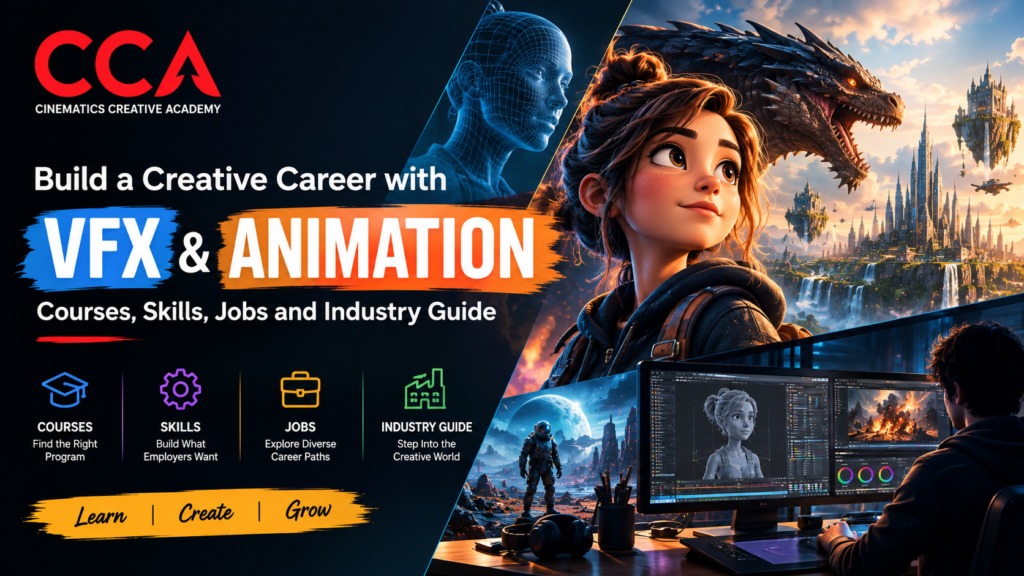
The entertainment industry has changed dramatically with the growth of streaming platforms, gaming, digital advertising, social media, and immersive content. Behind the visuals people watch every day are artists, designers, animators, compositors, editors, and technical specialists who transform creative ideas into engaging digital experiences.
Cinematics Creative Academy provides aspiring artists with an opportunity to explore this rapidly evolving creative field through its VFX and Animation Course. For students interested in filmmaking, 3D design, animation, visual effects, gaming, or digital content, structured training can provide a starting point for understanding professional workflows and developing practical creative skills.
But what exactly does a VFX and Animation course teach? Which career options are available after completing one? Do you need artistic skills before joining? And how are technologies such as AI and real-time 3D changing the industry?
This guide answers these questions and explains what students should know before choosing animation and VFX as a career path.
Understanding the World of VFX and Animation
Animation and visual effects are often discussed together, but they serve different purposes within digital production.
Animation is primarily concerned with creating movement. Characters, objects, graphics, environments, and other elements can be animated to communicate an action, emotion, or story.
Visual effects, on the other hand, are used to create or manipulate visual elements that may not be practical to capture completely through conventional photography. A production might use VFX to create a fictional environment, enhance a real location, add digital creatures, remove unwanted objects, or combine computer-generated elements with live-action footage.
Modern productions frequently bring these disciplines together.
A single sequence might involve a 3D artist creating an asset, a texture artist giving it a realistic surface, an animator creating movement, a lighting artist matching the scene’s illumination, and a compositor integrating everything with the original footage.
This makes VFX and animation collaborative fields rather than careers based around one software application.
What Does a VFX and Animation Course Cover?
The curriculum differs between institutions, but a well-rounded program can introduce students to several stages of digital content creation.
Common areas may include:
- 3D modelling
- Character creation
- 3D animation
- Texturing
- Lighting
- Rendering
- Compositing
- Motion graphics
- Visual effects
- Video editing
- Digital filmmaking
- Character design
- Storyboarding
- Visual storytelling
- Production workflows
Students can gradually understand how individual skills connect to a larger production pipeline.
For example, creating a digital character involves much more than modelling its appearance. The character may need textures, a digital rig, animation, lighting, rendering, and compositing before it becomes part of a finished sequence.
Why Choose Animation and VFX as a Career?
One of the biggest advantages of this field is the variety of creative directions available.
Someone who enjoys drawing may become interested in character design. A person fascinated by films might prefer compositing or filmmaking. Someone who enjoys technology and simulations could explore FX or procedural workflows.
The industry also extends beyond movies.
Creative professionals can find opportunities across:
- Film production
- Television
- OTT platforms
- Advertising
- Gaming
- Animation studios
- Digital agencies
- Social media production
- Corporate content
- Virtual production
- Experiential media
This diversity means students do not necessarily have to follow a single career route.
Essential Skills for Aspiring VFX Artists
Learning software is only one part of becoming a successful digital artist.
Visual Observation
Artists need to understand how real objects look and behave.
Studying real-world lighting, materials, movement, perspective, and proportions can improve the quality of digital work.
Creativity
Creative problem-solving is essential when a visual cannot be produced through a straightforward method.
Artists often need to experiment with different techniques to achieve a director’s or client’s vision.
Attention to Detail
A tiny mismatch in lighting, shadows, edges, perspective, or colour can make a visual appear unrealistic.
Developing the habit of checking small details can significantly improve finished work.
Understanding of Movement
For animation, understanding how bodies, objects, and characters move is fundamental.
Weight, acceleration, timing, balance, and rhythm all influence how convincing an animation feels.
Patience
Digital production can involve multiple revisions.
A shot may be changed several times based on feedback before it reaches its final version. Students who enjoy refining their work are often better prepared for this process.
Team Collaboration
Professional projects usually involve several departments working together.
Being able to communicate ideas, understand feedback, and coordinate with other artists is an important workplace skill.
Major Specializations Within VFX and Animation
One reason the field can feel confusing to beginners is the number of specialized roles involved in a production.
Here are some of the major areas students can explore.
3D Modelling
Modelling artists construct digital objects, characters, environments, vehicles, props, and other assets.
The work requires an understanding of shape, proportions, topology, structure, and detail.
Character Animation
Character animators bring digital characters to life.
Their work involves movement, body mechanics, facial expressions, acting, timing, and emotional performance.
Texturing
Texture artists create surface details that determine how an object appears.
A surface might need to look metallic, worn, glossy, rough, transparent, wooden, fabric-based, or organic.
Lighting
Lighting artists determine how digital scenes are illuminated.
Their work contributes to realism, atmosphere, depth, visual hierarchy, and storytelling.
Compositing
Compositors combine multiple visual elements into a finished frame.
A shot might contain live footage, CGI, digital backgrounds, atmospheric effects, shadows, colour adjustments, and other components.
The compositor’s job is to make the complete image appear visually consistent.
Rotoscopy
Rotoscopy involves creating accurate mattes around objects or people in footage.
It is often used when artists need to separate specific subjects from their backgrounds or selectively modify parts of a shot.
Matchmoving
Matchmove artists analyse camera or object movement so that digital elements can be positioned correctly within live-action footage.
Accurate tracking is particularly important when CGI needs to appear naturally integrated into a moving scene.
FX and Simulation
FX artists work on dynamic visual phenomena.
Depending on the production, this can involve:
- Smoke
- Fire
- Water
- Dust
- Particles
- Destruction
- Explosions
- Debris
This specialization often combines artistic judgement with technical knowledge.
Motion Graphics
Motion graphics combines graphic design and animation.
It is commonly used in advertising, social media, broadcast design, presentations, explainer videos, promotional campaigns, and branded content.
Software Used in the Animation and VFX Industry
Different departments use different tools, and software requirements can vary between studios.
Students may encounter applications such as:
Autodesk Maya
Maya is widely associated with 3D modelling, rigging, animation, and production workflows.
Blender
Blender provides tools for modelling, animation, rendering, simulation, and other aspects of 3D creation. It is widely used by independent artists as well as learners exploring 3D.
Adobe After Effects
After Effects is commonly used for motion graphics, compositing, animation, titles, and video-based visual effects.
Foundry Nuke
Nuke is particularly associated with professional compositing workflows.
Houdini
Houdini is known for procedural workflows and complex simulations, making it valuable for advanced FX work.
Cinema 4D
Cinema 4D is popular for 3D design and motion graphics workflows.
Unreal Engine
Real-time 3D platforms such as Unreal Engine are becoming increasingly relevant to virtual production, interactive experiences, games, and cinematic applications.
The goal should not be to learn every program available. Students should identify their preferred specialization and concentrate on the tools that support it.
How AI Is Influencing VFX and Animation
Artificial intelligence is becoming another component of modern creative workflows.
AI-powered applications can assist artists with tasks such as:
- Concept exploration
- Image generation
- Visual references
- Background creation
- Editing assistance
- Rotoscopy support
- Image enhancement
- Previsualization
- Creative experimentation
However, AI does not eliminate the need for artistic judgement.
Generated material still needs to be evaluated for consistency, composition, anatomy, lighting, perspective, continuity, and storytelling.
This makes creative fundamentals even more valuable.
Students entering the field can benefit from learning how to combine conventional production skills with emerging digital tools.
VFX and Animation Career Options
Completing training in animation and VFX can open the door to different creative roles.
Depending on their specialization and portfolio, students may explore careers such as:
- 3D Animator
- VFX Artist
- 3D Modelling Artist
- Character Artist
- Compositor
- Lighting Artist
- Texture Artist
- FX Artist
- Roto Artist
- Matchmove Artist
- Motion Graphics Designer
- Video Editor
- Environment Artist
- Game Artist
- Previsualization Artist
The actual responsibilities can vary significantly between studios.
A junior artist may initially work on specific production tasks before gradually taking on more complex assignments.
Where Can VFX Professionals Work?
Film and OTT
Movies and streaming productions use digital artists for environments, creatures, compositing, cleanup, simulations, digital assets, and many other requirements.
Advertising
Brands increasingly use CGI, motion graphics, animation, and digital effects to create distinctive advertising campaigns.
Gaming
Game studios require artists to develop characters, environments, props, effects, cinematics, and other visual assets.
Animation
Animation studios produce content for films, television, streaming platforms, educational projects, advertising, and digital entertainment.
Digital Marketing
Agencies and brands need motion designers, editors, animators, and VFX artists for short-form digital campaigns and social media content.
Virtual Production
Real-time environments and digital production systems are creating new possibilities for filmmaking, advertising, live experiences, and immersive media.
Can You Study VFX After 10th?
Students who have completed 10th can begin exploring animation and visual effects, depending on the eligibility criteria of the particular course.
At this stage, students can strengthen their creative foundation through:
- Drawing
- Digital art
- Basic design
- Photography
- Video editing
- Animation exercises
- 3D experimentation
Previous professional experience is generally not the starting point.
Curiosity and consistent practice are more important when beginning.
Can You Pursue VFX After 12th?
Yes, students completing 12th can explore different educational routes depending on their career goals.
Possible pathways include diploma programs, certificate courses, undergraduate programs, and specialized professional training.
When comparing courses, students should examine:
- Duration
- Curriculum
- Practical training
- Software
- Projects
- Faculty
- Infrastructure
- Portfolio development
- Career guidance
The best program is not necessarily the one with the longest list of software. It is the one that matches the student’s intended career direction.
Can Graduates Change Their Career to VFX?
A different academic background does not automatically prevent someone from entering the creative industry.
Graduates interested in animation or VFX can begin by learning the fundamentals and gradually develop specialization-specific skills.
A strong portfolio can be particularly important for career changers because it provides tangible evidence of their abilities.
Instead of relying entirely on academic qualifications, aspiring artists should focus on creating work that demonstrates what they can actually produce.
How to Build a Strong VFX Portfolio
Your portfolio is one of the most important assets you can develop during your training.
Instead of uploading every assignment, select projects that demonstrate your strongest skills.
A portfolio could contain:
- 3D models
- Character work
- Animation clips
- Compositing shots
- Motion graphics
- Environment designs
- Lighting studies
- FX simulations
- Before-and-after comparisons
- Project breakdowns
A focused portfolio is usually more effective than a collection of unrelated work.
For example, someone applying for a compositing role should highlight compositing work rather than filling the portfolio with unrelated graphic designs.
Why Showreels Matter
A showreel gives recruiters or clients a quick overview of an artist’s capabilities.
Keep it focused on the type of role you want.
If you are interested in animation, lead with your strongest animation shots.
If compositing is your target, showcase your best composites and breakdowns.
If you want to work in 3D modelling, demonstrate modelling quality, topology, texturing, and finished renders.
Do not include weak work simply to make the reel longer.
How to Choose the Right VFX Course
Selecting a course requires more research than simply comparing course names.
Look at the Curriculum
Check whether the subjects match your intended specialization.
Check Practical Exposure
Ask how frequently students create projects rather than only watching demonstrations.
Research Faculty
Experienced instructors can provide useful insights into production workflows and industry expectations.
Examine Infrastructure
3D rendering, simulation, editing, and VFX work can require suitable computer systems and production facilities.
Review Student Projects
Look at the quality and variety of work produced by students.
Understand Career Support
Find out whether the institute offers portfolio reviews, interview preparation, internship guidance, or other career-oriented support.
Consider the Learning Environment
A good creative education should encourage experimentation, feedback, and project development.
Common Mistakes Beginners Should Avoid
Trying to Master Every Software
You don’t need to become an expert in five or six applications at the beginning.
Choose one area and develop depth.
Copying Tutorials Without Understanding
Tutorials can teach techniques, but simply following instructions does not necessarily develop creative problem-solving.
After learning a technique, try using it to create something independently.
Ignoring Traditional Principles
Composition, colour, perspective, timing, lighting, and storytelling continue to matter regardless of how advanced technology becomes.
Creating Only One Project
Your first project teaches you what needs improvement.
Your second project can demonstrate progress.
Keep creating.
Neglecting Feedback
Constructive criticism can reveal problems that you may not notice yourself.
Learn to use feedback as part of the creative process.
A Practical Learning Roadmap for Beginners
A simple progression could look like this:
Stage 1 — Explore
Try different areas of animation, design, editing, and VFX.
Stage 2 — Learn
Build a foundation in visual principles and production concepts.
Stage 3 — Specialize
Choose an area that matches your interests.
Stage 4 — Practise
Create small exercises regularly.
Stage 5 — Develop Projects
Move from exercises to complete creative pieces.
Stage 6 — Build a Portfolio
Select your strongest work and present it professionally.
Stage 7 — Seek Experience
Explore internships, freelance projects, junior positions, collaborations, or other opportunities.
Stage 8 — Continue Learning
Technology and production workflows will keep changing, so professional development should continue throughout your career.
Is VFX and Animation a Good Career Choice?
The answer depends on what you enjoy.
This field can be rewarding for people who like creating visual content, experimenting with technology, solving creative problems, and working on detailed projects.
At the same time, it is important to understand that professional production is not always glamorous.
Artists may spend hours correcting small details, making revisions, testing alternatives, and responding to feedback.
The final cinematic shot might last only a few seconds, while creating it could involve many hours of work.
If you enjoy the process as much as the final result, animation and VFX can be an exciting career direction.
Frequently Asked Questions
What is a VFX and Animation Course?
It is a structured program that teaches students different creative and technical processes involved in animation, digital visual effects, 3D production, compositing, motion design, and related areas.
Is drawing necessary for VFX?
Drawing can be helpful for developing observation and visual thinking, but not every VFX specialization requires advanced drawing skills. Different departments require different abilities.
Is coding compulsory for animation?
No. Many animation and VFX roles are primarily creative. However, programming, scripting, and technical knowledge can be advantageous in certain specialized areas.
Which software should beginners learn?
It depends on the career direction. A future animator may focus on 3D animation software, while someone interested in compositing may need a different toolset.
Can I learn VFX after 10th?
Students can explore VFX and animation after 10th, subject to the eligibility conditions of the selected program.
Can I pursue VFX after 12th?
Yes. Students can consider diploma, certificate, undergraduate, or specialized professional programs according to their goals and eligibility.
Is VFX only used in movies?
No. VFX and animation are also used in advertising, gaming, OTT content, digital marketing, virtual production, social media, education, and other forms of digital communication.
Does AI replace VFX artists?
AI is changing certain workflows and can automate or assist with specific tasks, but creative judgement, artistic direction, production knowledge, and problem-solving remain important.
What is more important: software or creativity?
Both matter, but software is a tool. Strong creative fundamentals help artists use technology effectively rather than simply operate it.
Cinematics Creative Academy
Website: https://ccaindia.com/
Phone: +91 9152562222
Address: ABVKVK 3rd floor, Akurli Cross Rd Number 3, Kandivali East, Mumbai, Maharashtra 400101