
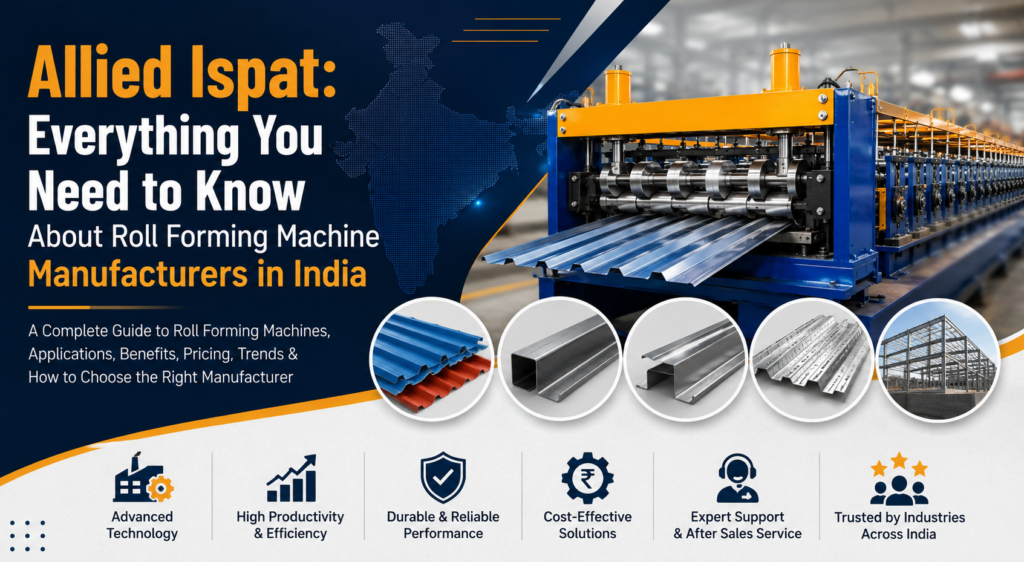
Introduction: Why Are More Construction Businesses Searching for Roll Forming Machines?
India’s construction and infrastructure sectors are expanding faster than ever before. From industrial warehouses and commercial complexes to pre-engineered buildings (PEBs), solar projects, logistics parks, and manufacturing facilities, steel-based construction has become the preferred choice for modern development.
But have you ever wondered how roofing sheets, purlins, deck sheets, wall panels, and structural steel profiles are manufactured with such precision?
The answer lies in advanced roll forming technology.
This is one of the biggest reasons why searches for Roll Forming Machine Manufacturer in India, Roofing Sheet Roll Forming Machine, and C Purlin Roll Forming Machine have increased significantly in recent years.
Whether you are a contractor planning to start your own manufacturing unit, a building material dealer looking to expand operations, or a PEB manufacturer searching for efficient production solutions, understanding roll forming technology can help you make informed business decisions.
In this comprehensive guide, we will explain:
- What a roll forming machine is
- How it works
- Industries that use roll forming technology
- Different types of roll forming machines
- Key advantages for construction businesses
- How to choose the right Roll Forming Machine Manufacturer in India
And most importantly, we’ll explain why leading manufacturers and construction businesses continue to invest in advanced solutions from Allied Ispat.
What Is a Roll Forming Machine?
A roll forming machine is an industrial system designed to continuously transform metal coils into specific shapes and profiles through a series of precision-engineered rollers.
Unlike traditional fabrication methods that require multiple processes such as bending, cutting, and welding, roll forming creates finished profiles in a continuous production cycle.
This process delivers:
- Higher production speeds
- Better dimensional accuracy
- Consistent product quality
- Reduced material wastage
- Lower manufacturing costs
Because of these benefits, businesses searching for a reliable Roll Forming Machine Manufacturer in India often view roll forming as a long-term investment rather than just a machine purchase.
How Does a Roll Forming Machine Work?
Many first-time buyers search online for:
“How does a roll forming machine work?”
The process is surprisingly efficient.
Step 1: Coil Loading
Production begins with a steel coil mounted on a decoiler.
Common materials include:
- Galvanized Steel
- PPGI Sheets
- CR Steel
- Stainless Steel
- Aluminum
The machine automatically feeds the material into the production line.
Step 2: Material Straightening
Before forming begins, leveling rollers remove any inconsistencies from the coil.
This ensures smooth processing and accurate dimensions.
Step 3: Progressive Roll Forming
The sheet passes through multiple roller stations.
Each station gradually changes the shape of the material until the desired profile is achieved.
Unlike press braking, which bends metal in stages, roll forming shapes the profile continuously.
Step 4: Punching and Notching
Modern Automatic Roll Forming Machines can include integrated punching systems for:
- Holes
- Slots
- Mounting points
- Custom designs
This eliminates secondary operations.
Step 5: Hydraulic Cutting
The formed profile is automatically cut according to programmed lengths.
This improves production accuracy and reduces manual intervention.
Step 6: Finished Product Collection
Completed profiles are stacked and prepared for transportation or installation.
The entire process operates with exceptional efficiency, making roll forming one of the most productive manufacturing technologies available today.
Why Roll Forming Technology Is Transforming India’s Construction Industry
India’s construction sector faces increasing pressure to deliver projects faster while maintaining quality standards.
Developers demand:
- Faster project completion
- Better structural performance
- Lower labor costs
- Consistent material quality
- Reduced construction waste
Roll formed products help achieve all these goals.
This explains why searches for Roll Forming Machine for Construction Industry continue to rise.
Today, roll formed components are widely used in:
Roofing Systems
Industrial and commercial buildings require durable roofing sheets that can withstand harsh weather conditions.
Roll forming machines produce:
- Corrugated roofing sheets
- Trapezoidal roofing sheets
- Color-coated roofing panels
- Standing seam roofing profiles
Structural Components
Steel structures depend heavily on roll formed profiles such as:
- C Purlins
- Z Purlins
- Channels
- Beams
These components provide strength while reducing overall material consumption.
Floor Decking Systems
Modern multi-story buildings increasingly use deck sheets for faster construction and improved load distribution.
Solar Mounting Structures
India’s renewable energy expansion has created growing demand for precision-engineered solar mounting profiles.
Roll forming technology makes large-scale production possible while maintaining strict dimensional accuracy.
Types of Roll Forming Machines Used in India
Different industries require different profile designs.
As a result, every leading Roll Forming Machine Manufacturer in India offers a variety of machine configurations.
Roofing Sheet Roll Forming Machine
One of the most searched terms in the industry is:
Roofing Sheet Roll Forming Machine
These machines manufacture:
- Corrugated sheets
- Industrial roofing sheets
- Trapezoidal sheets
- Color-coated roofing panels
Applications include:
- Factories
- Warehouses
- Agricultural sheds
- Commercial complexes
- Logistics centers
As infrastructure development continues, demand for roofing sheet manufacturing machines remains strong.
C Purlin Roll Forming Machine
C purlins are critical structural elements in steel construction.
A C Purlin Roll Forming Machine is designed to manufacture profiles used in:
- Warehouses
- Industrial sheds
- PEB structures
- Commercial buildings
Benefits include:
- High production speed
- Consistent dimensions
- Reduced steel wastage
- Strong load-bearing capacity
Many construction companies now prefer automated C purlin production lines to improve efficiency.
Z Purlin Roll Forming Machine
For larger structures, Z purlins offer additional strength and design flexibility.
A Z Purlin Roll Forming Machine enables manufacturers to produce profiles used in:
- Airports
- Industrial parks
- Distribution centers
- Large-span buildings
Advantages include:
- Better load distribution
- Longer structural spans
- Reduced steel consumption
- Improved construction efficiency
Deck Sheet Roll Forming Machine
Commercial and infrastructure projects increasingly use deck sheets.
A Deck Sheet Roll Forming Machine produces profiles that support concrete slabs during construction.
Benefits include:
- Faster construction timelines
- Reduced formwork requirements
- Improved structural integrity
- Lower project costs
Because of these advantages, deck sheet demand continues to grow across India’s commercial construction sector.
C and Z Purlin Combination Machines
Many businesses search for:
C and Z Purlin Machine
These machines provide flexibility by producing both C and Z profiles on a single production line.
Advantages include:
- Reduced equipment investment
- Higher production versatility
- Faster profile changeovers
- Better ROI
This option is particularly attractive for growing manufacturing businesses.
Custom Roll Forming Machines
Not every project requires standard profiles.
Many industries need customized solutions.
Applications include:
- Solar panel mounting systems
- Cable trays
- Automotive profiles
- Electrical enclosures
- Structural components
- Infrastructure products
An experienced Roll Forming Machine Manufacturer in India can design machines specifically for these applications.
Industries That Depend on Roll Forming Technology
Most people associate roll forming with roofing sheets.
However, the technology supports multiple industries.
Construction Industry
Construction remains the largest user of roll formed products.
Common applications include:
- Roofing systems
- Wall cladding
- Structural framing
- Floor decking
- Building components
Pre-Engineered Building (PEB) Sector
India’s PEB industry is experiencing rapid growth.
Manufacturers rely on:
- Roofing sheet machines
- C purlin machines
- Z purlin machines
- Deck sheet production lines
to meet rising demand.
Solar Industry
The renewable energy sector requires:
- Solar mounting channels
- Support structures
- Frame profiles
Roll forming ensures consistent quality and high-volume production.
Infrastructure Development
Large-scale projects use roll formed components in:
- Airports
- Metro stations
- Railway terminals
- Industrial corridors
- Logistics hubs
The increasing number of government infrastructure projects is expected to further boost demand for roll forming equipment.
Benefits of Investing in Modern Roll Forming Machines
Many construction companies, roofing sheet manufacturers, and building material distributors often ask:
“Is investing in a roll forming machine worth it?”
The answer depends on your production goals, but for businesses involved in steel processing and construction materials, the benefits are significant.
1. Higher Production Capacity
Traditional fabrication methods require multiple steps and extensive manpower. Roll forming technology streamlines production by continuously shaping metal coils into finished profiles.
Benefits include:
- Faster production cycles
- Increased output per shift
- Reduced production bottlenecks
- Ability to fulfill large orders quickly
For growing businesses, this means more opportunities to serve larger projects without increasing labor costs.
2. Consistent Product Quality
Quality consistency is critical in the construction industry.
Modern Automatic Roll Forming Machines ensure:
- Uniform dimensions
- Precise profile shapes
- Consistent thickness control
- Improved installation compatibility
This reduces customer complaints and strengthens brand reputation.
3. Lower Material Waste
Material wastage directly impacts profitability.
Advanced roll forming systems are designed to maximize material utilization, helping manufacturers reduce scrap generation and improve operational efficiency.
4. Reduced Labor Dependency
Labor shortages and increasing wages continue to affect manufacturing operations across India.
Automated roll forming equipment helps businesses:
- Reduce manual intervention
- Improve production reliability
- Minimize human error
- Increase operational efficiency
5. Better Return on Investment
Although the initial investment may appear substantial, modern roll forming technology often delivers excellent long-term returns through:
- Increased production
- Lower operating costs
- Reduced wastage
- Improved product quality
This is why many businesses choose to partner with experienced companies like Allied Ispat when expanding their manufacturing capabilities.
Roll Forming Machine Price in India: What Affects the Cost?
One of the most searched queries online is:
What Is the Roll Forming Machine Price in India?
There is no single answer because pricing depends on several factors.
Machine Type
Different machines require different engineering configurations.
Examples include:
- Roofing Sheet Roll Forming Machine
- Corrugated Sheet Roll Forming Machine
- Trapezoidal Roofing Sheet Machine
- C Purlin Roll Forming Machine
- Z Purlin Roll Forming Machine
- Deck Sheet Roll Forming Machine
Machines producing complex profiles generally require more roll stations and specialized tooling.
Automation Level
A fully automated system typically includes:
- PLC controls
- Touchscreen interfaces
- Servo feeding
- Automatic length control
- Hydraulic cutting
These features increase productivity and accuracy while affecting machine pricing.
Production Speed
Higher-speed machines require:
- Advanced drive systems
- Heavy-duty frames
- Precision engineering
As production capacity increases, machine costs also increase.
Material Thickness Range
Machines capable of processing thicker materials require stronger construction and more powerful components.
This influences overall investment requirements.
Customization Requirements
Many manufacturers require custom profile designs.
Customized machines may include:
- Special punching units
- Multiple profile capabilities
- Integrated stacking systems
- Automated profile adjustments
These customizations impact pricing but can significantly improve production flexibility.
How to Choose the Right Roll Forming Machine Manufacturer in India
Choosing machinery is not simply about buying equipment.
You are selecting a long-term manufacturing partner.
This is why searches for:
- Best Roll Forming Machine Manufacturer in India
- Roll Forming Machine Supplier India
- Roll Forming Machine Buying Guide
continue to grow.
Here are key factors to evaluate.
Industry Experience
An experienced manufacturer understands real-world production challenges.
Before making a decision, review:
- Years in business
- Manufacturing expertise
- Customer base
- Installed machine portfolio
- Industry reputation
Companies with proven experience are more likely to deliver reliable solutions.
Custom Engineering Capability
Every manufacturing business has unique requirements.
A capable manufacturer should offer:
- Profile design support
- Machine customization
- Production line integration
- Specialized tooling solutions
This flexibility becomes especially important for businesses serving niche markets.
Technology and Automation
Modern manufacturing increasingly depends on automation.
Look for features such as:
- PLC automation
- Servo control systems
- Remote diagnostics
- Touchscreen operation
- Automated profile adjustments
These technologies improve productivity while reducing downtime.
After-Sales Support
A machine is only as good as the support behind it.
Ask about:
- Installation services
- Operator training
- Spare parts availability
- Technical assistance
- Maintenance programs
Reliable after-sales support protects your investment and minimizes production interruptions.
Quality Standards
Always verify:
- Manufacturing quality
- Component quality
- Engineering processes
- Testing procedures
High-quality equipment typically delivers better long-term performance and lower maintenance costs.
Roll Forming vs Press Brake: Which Is Better?
Another common question from buyers is:
What Is the Difference Between Roll Forming and Press Brake Technology?
Although both processes shape metal, they serve different manufacturing requirements.
Roll Forming Advantages
Roll forming is ideal for:
- High-volume production
- Continuous manufacturing
- Consistent profiles
- Reduced labor requirements
- Lower cost per unit
It is commonly used for:
- Roofing sheets
- Purlins
- Deck sheets
- Wall panels
- Structural profiles
Press Brake Advantages
Press brakes are better suited for:
- Small production batches
- Custom fabrication
- Low-volume orders
- Frequent design changes
Which Is Better?
For manufacturers producing construction materials and structural components, roll forming generally offers better productivity, scalability, and profitability.
This explains the growing demand for Industrial Roll Forming Machines across India.
Latest Trends in Roll Forming Technology
The roll forming industry continues to evolve.
Businesses investing in new equipment should understand where the market is heading.
Industry 4.0 Integration
Modern machines increasingly include smart manufacturing features such as:
- Real-time production monitoring
- Performance analytics
- Cloud connectivity
- Remote diagnostics
These technologies help manufacturers improve operational efficiency.
High-Speed Production Lines
Demand for construction materials continues to rise.
Manufacturers are responding by developing faster production systems capable of handling larger volumes without compromising quality.
Energy-Efficient Machines
Reducing operational costs remains a priority.
Modern systems now feature:
- Energy-efficient motors
- Optimized drive systems
- Improved hydraulic technology
This helps businesses reduce power consumption while maintaining productivity.
Flexible Profile Production
Manufacturers increasingly require machines capable of producing multiple profile types.
Flexible tooling systems allow:
- Faster profile changes
- Reduced downtime
- Greater production versatility
This trend is especially important for businesses serving multiple industries.
AI-Driven Manufacturing
Artificial Intelligence is beginning to influence industrial operations.
Future roll forming systems may offer:
- Predictive maintenance
- Automated quality inspection
- Production optimization
- Performance forecasting
These innovations are expected to further improve manufacturing efficiency.
Why Allied Ispat Is a Preferred Roll Forming Machine Manufacturer in India
In today’s competitive manufacturing environment, businesses need more than machinery.
They need a reliable partner capable of supporting long-term growth.
This is where Allied Ispat continues to earn the trust of customers across India.
Industry-Focused Expertise
With extensive experience serving India’s construction and steel industries, Allied Ispat understands the unique challenges faced by:
- Construction companies
- Roofing sheet manufacturers
- PEB manufacturers
- Steel fabricators
- Building material distributors
This industry knowledge helps customers choose the right solution for their production requirements.
Advanced Manufacturing Solutions
Allied Ispat offers machinery designed to deliver:
- High productivity
- Long-term reliability
- Precision engineering
- Operational efficiency
Every machine is developed to meet the demands of modern manufacturing environments.
Custom Machine Development
Not every customer requires a standard production line.
Allied Ispat provides customized solutions for:
- Roofing sheet production
- C purlin manufacturing
- Z purlin manufacturing
- Deck sheet production
- Solar profile manufacturing
- Specialized steel profiles
This flexibility helps businesses remain competitive in evolving markets.
Customer-Centric Approach
From consultation to installation and ongoing support, Allied Ispat focuses on building long-term partnerships.
Customers benefit from:
- Technical guidance
- Installation assistance
- Operator training
- Spare parts support
- Maintenance recommendations
This commitment helps maximize machine performance and business profitability.
Frequently Asked Questions
What is a roll forming machine?
A roll forming machine is a continuous metal forming system used to manufacture steel profiles such as roofing sheets, purlins, deck sheets, wall panels, and structural components.
Which industries use roll forming machines?
Common industries include:
- Construction
- Infrastructure
- Renewable Energy
- Automotive
- Steel Fabrication
- Industrial Manufacturing
What is the price of a roll forming machine in India?
The price depends on machine type, production capacity, automation level, customization requirements, and material processing capabilities.
What products can be manufactured using roll forming machines?
Examples include:
- Roofing Sheets
- Corrugated Sheets
- Trapezoidal Sheets
- C Purlins
- Z Purlins
- Deck Sheets
- Wall Panels
- Solar Profiles
- Structural Channels
How do I choose the best Roll Forming Machine Manufacturer in India?
Consider:
- Industry experience
- Technical expertise
- Customization capability
- Automation features
- After-sales support
- Manufacturing quality
What are the benefits of roll forming technology?
Major benefits include:
- High production speed
- Consistent quality
- Reduced material waste
- Lower manufacturing costs
- Improved ROI
- Greater production efficiency
Conclusion
As India’s construction, infrastructure, and industrial sectors continue to expand, the demand for precision-engineered steel components is increasing rapidly. This growth has made roll forming technology one of the most important manufacturing solutions for businesses involved in roofing systems, structural steel, PEB construction, deck sheet production, and industrial fabrication.
For construction companies, contractors, and building material distributors, investing in advanced roll forming equipment can significantly improve productivity, product quality, and long-term profitability. However, the success of that investment depends heavily on choosing the right Roll Forming Machine Manufacturer in India.
Businesses should evaluate manufacturers based on engineering expertise, customization capabilities, automation technology, service support, and long-term reliability.
With its commitment to innovation, quality engineering, and customer-focused solutions, Allied Ispat continues to support manufacturers across India with advanced roll forming systems designed to meet modern production demands.
Whether you’re planning to start a new manufacturing unit or expand your existing operations, selecting the right machinery partner today can help position your business for sustained growth and success in the years ahead.
Allied Ispat
Address: Shop 69, Maulana Shaukat Ali Road, Chhota Sonapur, Siddharth Nagar, Mumbai Central, Mumbai, Maharashtra 400008, India
Phone: +91 98211 77009
Website: https://alliedispatindia.com/
Directions: https://maps.app.goo.gl/TgKaNL1UwkF4MESf9