
Introduction
India is witnessing one of the largest construction and infrastructure expansions in its history. From highways and metro rail projects to industrial parks, warehouses, logistics hubs, airports, and pre-engineered buildings, the demand for high-quality steel components continues to grow rapidly.
Behind these modern structures lies a manufacturing technology that has transformed the way steel profiles are produced—roll forming.
For construction companies, contractors, roofing sheet manufacturers, and building material distributors, understanding the value of advanced roll forming technology is no longer optional. It has become a strategic investment that directly impacts production efficiency, project timelines, product quality, and profitability.
As businesses search for a reliable Roll Forming Machine Manufacturer in India, they are often looking for solutions that can help them reduce costs, increase output, and meet growing market demand.
Companies like Allied Ispat have been supporting India’s evolving construction sector by providing modern roll forming solutions designed to meet the requirements of today’s fast-paced manufacturing environment.
In this guide, we’ll explore why advanced roll forming machines are becoming an essential investment for the construction and infrastructure industry, how they improve productivity, and what buyers should consider before making an investment.
What Is a Roll Forming Machine?
Before discussing the benefits, it’s important to understand the technology itself.
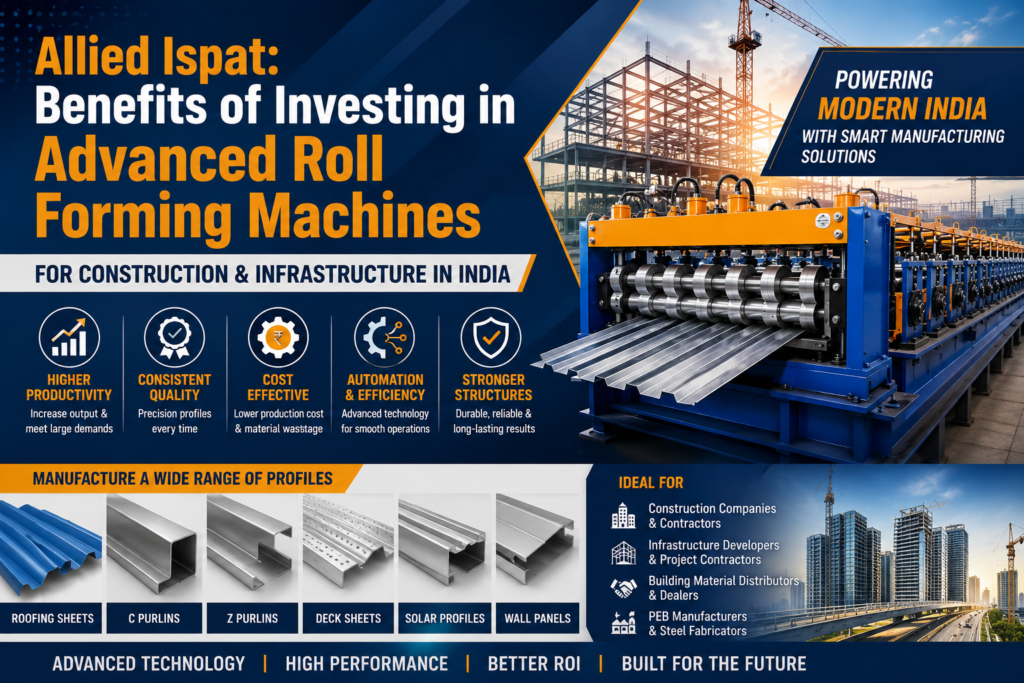
A roll forming machine is an industrial system that continuously converts metal coils into finished profiles through a sequence of precisely engineered roller stations.
Instead of shaping metal through multiple fabrication processes, roll forming gradually bends the material into the desired profile while maintaining consistency and accuracy throughout production.
The process is commonly used for manufacturing:
- Roofing sheets
- Wall panels
- C purlins
- Z purlins
- Deck sheets
- Structural channels
- Solar mounting structures
- Cable trays
- Door and window frames
This continuous manufacturing process has become one of the most efficient methods for producing steel profiles at scale.
Why Is Roll Forming Technology Becoming Essential in India?
India’s construction landscape has changed dramatically over the last decade.
Projects today demand:
- Faster completion times
- Lower project costs
- Consistent product quality
- Greater structural reliability
- Sustainable construction practices
Traditional fabrication methods often struggle to meet these expectations.
Modern roll forming technology offers a practical solution by enabling manufacturers to produce large volumes of steel profiles quickly and accurately.
This is one reason why searches for Roll Forming Machine Manufacturer in India and Industrial Roll Forming Machine continue to grow year after year.
Benefits of Investing in Advanced Roll Forming Machines
1. Significantly Higher Production Output
One of the biggest advantages of modern roll forming systems is production speed.
Unlike conventional fabrication methods that require multiple handling stages, roll forming operates as a continuous process.
This allows manufacturers to produce profiles at much higher volumes without compromising accuracy.
For example:
- Roofing sheet manufacturers can increase daily production capacity.
- PEB manufacturers can meet larger project demands.
- Building material suppliers can reduce delivery lead times.
For businesses operating in highly competitive markets, production speed often becomes a major competitive advantage.
2. Consistent Product Quality Across Every Batch
Construction companies cannot afford inconsistencies in building materials.
Variations in profile dimensions can lead to:
- Installation delays
- Structural issues
- Material wastage
- Increased project costs
Advanced roll forming machines eliminate these problems through automated production systems.
Every profile produced maintains:
- Uniform dimensions
- Consistent thickness
- Precise shape accuracy
- Better fitting performance
This level of consistency is particularly important for infrastructure projects where quality standards are strict.
Manufacturers working with Allied Ispat often prioritize machine accuracy because it directly affects project performance and customer satisfaction.
3. Reduced Material Wastage
Material costs represent a significant portion of manufacturing expenses.
Traditional fabrication processes frequently generate excess scrap due to:
- Manual errors
- Inconsistent cutting
- Multiple processing stages
Modern automatic roll forming machines minimize waste by ensuring accurate forming and cutting operations.
Benefits include:
- Lower raw material consumption
- Reduced scrap generation
- Improved inventory management
- Higher profitability
Over time, these savings can substantially improve overall business performance.
Why Construction Companies Are Investing in Roll Forming Technology
The construction sector is becoming increasingly competitive.
Developers want:
- Faster project delivery
- Better quality materials
- Reduced construction costs
Contractors want:
- Reliable suppliers
- Consistent inventory
- High-performance building components
Roll forming technology addresses all these requirements.
Products manufactured through roll forming systems are widely used in:
- Industrial buildings
- Commercial complexes
- Warehouses
- Logistics centers
- Agricultural structures
- Infrastructure projects
As a result, many companies now consider advanced roll forming machinery a strategic investment rather than simply manufacturing equipment.
How Roll Forming Machines Support Infrastructure Development
India’s infrastructure sector continues to expand rapidly.
Government and private investments are driving growth in:
- Railway projects
- Airports
- Metro systems
- Industrial corridors
- Smart cities
- Logistics parks
These projects require large quantities of steel profiles manufactured to exact specifications.
Roll forming machines help meet these demands efficiently.
Common infrastructure applications include:
Structural Components
Used for:
- Industrial structures
- Bridges
- Stations
- Utility buildings
Roofing Systems
Manufactured using:
- Roofing Sheet Roll Forming Machine
- Corrugated Sheet Roll Forming Machine
- Trapezoidal Roofing Sheet Machine
Floor Decking
Produced using:
- Deck Sheet Roll Forming Machine
- Floor Deck Sheet Machine
These components improve construction speed while maintaining structural performance.
What Products Can Be Manufactured Using Roll Forming Machines?
Many buyers researching a Roll Forming Machine Manufacturer in India often ask this question.
The answer is extensive.
Advanced machines can manufacture:
Roofing Sheets
Commonly used for:
- Factories
- Warehouses
- Commercial buildings
- Industrial sheds
Popular machine categories include:
- Roofing Sheet Roll Forming Machine
- Metal Roofing Sheet Machine
- Color Roofing Sheet Machine
C Purlins
C purlins are widely used in:
- Steel structures
- PEB projects
- Industrial buildings
Manufactured using:
- C Purlin Roll Forming Machine
- Automatic Purlin Roll Forming Machine
Z Purlins
Designed for larger structural spans.
Benefits include:
- Better load distribution
- Reduced steel usage
- Improved structural performance
Manufactured using:
- Z Purlin Roll Forming Machine
- C and Z Purlin Machine
Deck Sheets
Deck sheets play a critical role in modern construction.
Produced using:
- Deck Sheet Roll Forming Machine
- Composite Deck Sheet Machine
- Metal Decking Machine
Benefits include:
- Faster floor construction
- Improved load-bearing capability
- Reduced construction time
How Does an Automatic Roll Forming Machine Improve Productivity?
This is one of the most common Google search questions among manufacturers.
The answer lies in automation.
Modern machines incorporate:
- PLC control systems
- Touchscreen interfaces
- Servo feeding mechanisms
- Automatic cutting systems
- Hydraulic punching units
These features reduce manual intervention and improve efficiency.
As a result, businesses experience:
- Faster production cycles
- Reduced labor requirements
- Fewer operational errors
- Higher throughput
For growing businesses, automation creates opportunities to scale production without significantly increasing operational costs.
Roll Forming vs Traditional Metal Fabrication
Many business owners compare roll forming with conventional fabrication techniques.
While traditional methods still serve certain applications, roll forming offers significant advantages for high-volume manufacturing.
Traditional Fabrication
Typically involves:
- Multiple processing stages
- Manual handling
- Slower production rates
- Higher labor requirements
Roll Forming
Offers:
- Continuous production
- Greater consistency
- Lower operating costs
- Reduced material waste
- Faster delivery timelines
For manufacturers serving the construction industry, roll forming often delivers superior long-term value.
Understanding the Return on Investment (ROI) of Roll Forming Machines
One of the most important questions buyers ask before investing in industrial machinery is:
“Will the investment generate long-term returns?”
When it comes to advanced roll forming technology, the answer is often yes.
Unlike equipment that becomes obsolete quickly, a high-quality roll forming machine can continue delivering value for years through increased production capacity and lower operational costs.
Key Factors That Improve ROI
Higher Production Capacity
Advanced roll forming systems can manufacture thousands of meters of profiles in a single shift, helping businesses handle larger orders without increasing manpower.
Reduced Labor Costs
Automation significantly reduces manual operations, allowing businesses to optimize workforce allocation while maintaining productivity.
Lower Material Waste
Precision forming minimizes scrap generation, helping manufacturers reduce raw material costs and improve profitability.
Faster Project Delivery
For contractors and construction material suppliers, faster production means quicker deliveries and improved customer satisfaction.
For companies operating in the infrastructure sector, these benefits contribute directly to improved margins and stronger business growth.
What Is the Roll Forming Machine Price in India?
This is one of the most searched questions online.
However, there is no universal price because machine costs depend on several variables.
Factors Affecting Roll Forming Machine Cost
Machine Type
Different profiles require different tooling configurations.
Examples include:
- Roofing Sheet Roll Forming Machine
- C Purlin Roll Forming Machine
- Z Purlin Roll Forming Machine
- Deck Sheet Roll Forming Machine
- Solar Structure Profile Machine
Each machine type has different engineering requirements.
Automation Level
A fully automatic roll forming machine generally requires a higher initial investment compared to semi-automatic equipment.
However, automation often delivers better long-term returns through:
- Increased efficiency
- Reduced labor costs
- Improved accuracy
- Higher production output
Production Speed
Machines designed for high-volume manufacturing require:
- More roller stations
- Heavy-duty frames
- Powerful motors
- Advanced control systems
These features influence pricing but also improve productivity.
Customization Requirements
Many businesses require customized profiles for specific applications.
Custom machinery may include:
- Punching units
- Notching stations
- Hydraulic cutting systems
- Profile-specific tooling
Custom engineering can affect overall investment costs.
Why Construction Companies Prefer Advanced Roll Forming Solutions
Construction timelines are becoming shorter while quality expectations continue to increase.
As a result, contractors are looking for suppliers that can provide:
- Faster material availability
- Consistent product quality
- Cost-effective solutions
Roll forming technology helps manufacturers meet these demands efficiently.
Benefits for Contractors
- Faster installation
- Accurate profile dimensions
- Reduced material wastage on-site
- Better structural performance
Benefits for Building Material Dealers
- Consistent inventory supply
- Faster order fulfillment
- Improved customer retention
- Better profit margins
This growing demand is one reason searches for Best Roll Forming Machine Manufacturer in India continue to rise.
How to Choose the Best Roll Forming Machine Manufacturer in India
Selecting the right supplier is just as important as selecting the machine itself.
A machine is a long-term investment, and the quality of support you receive can directly impact business performance.
Evaluate Manufacturing Experience
Look for manufacturers with proven industry experience and successful installations across multiple sectors.
Questions to ask include:
- How many years have they been manufacturing machines?
- Which industries do they serve?
- Do they offer customized solutions?
Assess Engineering Capabilities
A reliable manufacturer should be capable of delivering:
- Standard machines
- Customized machinery
- Advanced automation solutions
- Future upgrade options
Verify After-Sales Support
Even the best machinery requires ongoing maintenance.
Look for suppliers offering:
- Technical support
- Operator training
- Spare parts availability
- Installation assistance
Strong support minimizes downtime and protects your investment.
Consider Long-Term Value
Instead of focusing solely on purchase price, evaluate:
- Machine durability
- Energy efficiency
- Production capability
- Maintenance requirements
The lowest-priced machine is not always the most cost-effective option.
Latest Trends in Roll Forming Technology
Manufacturing technology continues to evolve rapidly.
Businesses investing today should understand where the industry is heading.
Smart Manufacturing Integration
Industry 4.0 is transforming industrial production.
Modern roll forming systems increasingly include:
- Real-time production monitoring
- Cloud-based diagnostics
- IoT connectivity
- Data-driven maintenance systems
These technologies help manufacturers improve operational efficiency and reduce unexpected downtime.
High-Speed Production Systems
As demand grows, manufacturers are adopting faster production lines capable of producing larger volumes while maintaining profile accuracy.
This trend is particularly important for:
- Roofing sheet manufacturers
- PEB manufacturers
- Infrastructure suppliers
Energy-Efficient Machinery
Rising energy costs are encouraging manufacturers to invest in efficient production equipment.
Modern machines feature:
- Energy-saving motors
- Optimized hydraulic systems
- Reduced power consumption
This lowers operating costs while improving sustainability.
Flexible Profile Manufacturing
Today’s market requires greater versatility.
Manufacturers increasingly prefer machines capable of producing multiple profiles with minimal setup changes.
Benefits include:
- Faster changeovers
- Reduced tooling costs
- Greater production flexibility
Why Allied Ispat Is a Trusted Name in Roll Forming Solutions
When businesses search for a reliable Roll Forming Machine Manufacturer in India, they are looking for more than machinery.
They are looking for a long-term manufacturing partner.
Allied Ispat has established itself as a trusted provider of roll forming solutions by focusing on quality engineering, customer support, and industry-specific expertise.
Industry Understanding
The company understands the evolving requirements of:
- Construction companies
- Roofing sheet manufacturers
- Infrastructure developers
- PEB manufacturers
- Steel fabricators
This industry knowledge helps deliver practical manufacturing solutions that support business growth.
Focus on Quality
Every manufacturing operation depends on machine reliability.
Allied Ispat emphasizes:
- Precision engineering
- Durable machine construction
- Consistent production performance
- Long operational life
Customized Solutions
Different industries require different profiles.
Allied Ispat supports businesses requiring customized roll forming systems for:
- Roofing applications
- Structural profiles
- Deck sheets
- Purlins
- Specialized steel components
Customer-Centric Approach
The company’s commitment extends beyond machine installation.
Customers benefit from:
- Technical consultation
- Installation support
- Training assistance
- Ongoing service guidance
This long-term approach helps maximize operational efficiency and machine performance.
Frequently Asked Questions
What are the benefits of roll forming machines?
Roll forming machines offer high production speed, consistent quality, reduced waste, lower labor costs, and excellent scalability for industrial manufacturing.
Why should construction companies invest in roll forming machines?
They enable faster production of roofing sheets, purlins, deck sheets, and structural components while reducing project costs and improving material quality.
What is a roll forming machine used for?
Roll forming machines are used to manufacture steel profiles such as roofing sheets, wall panels, C purlins, Z purlins, deck sheets, and structural sections.
How does a roll forming machine improve productivity?
Automation allows continuous production with minimal manual intervention, increasing output while maintaining consistency.
Which industries use roll forming machines?
Common industries include:
- Construction
- Infrastructure
- Renewable Energy
- Steel Fabrication
- Automotive
- Industrial Manufacturing
What products can be manufactured using roll forming machines?
Examples include:
- Roofing Sheets
- Wall Panels
- C Purlins
- Z Purlins
- Deck Sheets
- Solar Mounting Profiles
- Structural Steel Components
What is the difference between roll forming and traditional metal fabrication?
Roll forming is a continuous, automated process designed for high-volume production, whereas traditional fabrication often involves multiple manual operations and lower production efficiency.
How do roll forming machines reduce production costs?
They reduce labor requirements, material waste, downtime, and production errors while improving manufacturing speed.
Which is the best Roll Forming Machine Manufacturer in India?
The ideal choice depends on your production requirements, machine quality expectations, customization needs, and after-sales support. Businesses should evaluate experience, engineering expertise, and customer support before making a decision.
Conclusion
India’s construction and infrastructure sectors are entering a period of unprecedented growth. To meet increasing demand, manufacturers need production systems capable of delivering speed, precision, and scalability.
Advanced roll forming technology has become a critical solution for producing roofing sheets, purlins, deck sheets, and structural steel profiles efficiently and cost-effectively.
Whether you are a contractor looking for reliable building materials, a distributor seeking consistent inventory supply, or a manufacturer planning to expand production capacity, investing in modern roll forming equipment can create long-term competitive advantages.
Partnering with an experienced Roll Forming Machine Manufacturer in India can help businesses improve productivity, reduce operational costs, and strengthen their position in an increasingly competitive marketplace.
With a commitment to quality engineering and customer-focused solutions, Allied Ispat continues to support the evolving needs of India’s construction and infrastructure industries through advanced roll forming technology designed for modern manufacturing success.
Allied Ispat
Address: Shop 69, Maulana Shaukat Ali Road, Chhota Sonapur, Siddharth Nagar, Mumbai Central, Mumbai, Maharashtra 400008, India
Phone: +91 98211 77009
Website: https://alliedispatindia.com/
Google Maps: https://maps.app.goo.gl/TgKaNL1UwkF4MESf9