
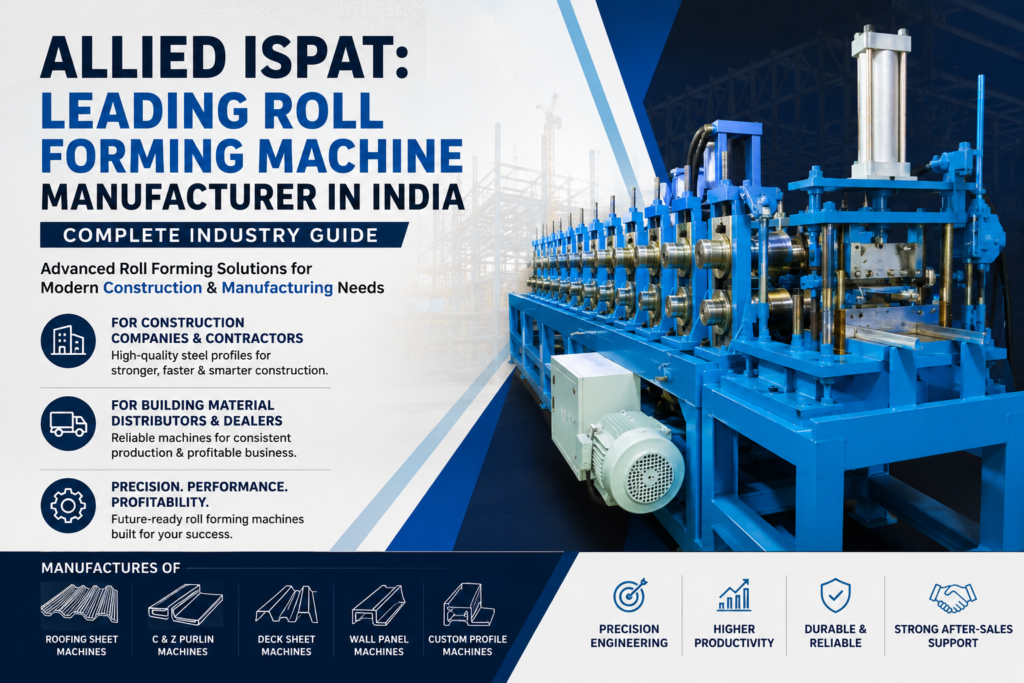
Introduction
India’s construction and infrastructure sectors are growing at an unprecedented pace. From industrial warehouses and commercial complexes to residential projects and large-scale infrastructure developments, the demand for precision-engineered steel components continues to rise. Behind many of these structures lies a technology that often goes unnoticed but plays a critical role in modern manufacturing—roll forming.
Whether you are a construction company, contractor, roofing sheet manufacturer, building material distributor, or industrial project developer, understanding roll forming technology can help you make better investment decisions and improve project efficiency.
This comprehensive guide explores everything you need to know about roll forming machines, their applications, benefits, and how to choose the right Roll Forming Machine Manufacturer in India for your business needs.
As one of the trusted names in the industry, Allied Ispat has been helping businesses across India achieve higher productivity with advanced roll forming solutions designed for modern manufacturing requirements.
What Is a Roll Forming Machine and How Does It Work?
A roll forming machine is a specialized metal processing system used to continuously bend sheet metal into desired profiles through a series of precisely engineered rollers.
Unlike conventional metal fabrication methods that involve cutting, welding, or multiple forming operations, roll forming creates complex profiles in a continuous process, resulting in greater efficiency, consistency, and production speed.
How the Roll Forming Process Works
The process begins with a metal coil, typically made of:
- Galvanized Steel
- Cold Rolled Steel
- Pre-Painted Galvanized Iron (PPGI)
- Stainless Steel
- Aluminum
The metal coil is fed into the machine where it passes through multiple roller stations. Each station gradually shapes the material until the final profile is achieved.
The process generally includes:
1. Coil Feeding
The metal coil is loaded onto a decoiler that feeds material into the machine.
2. Leveling
The sheet is straightened to ensure uniformity throughout production.
3. Progressive Forming
Multiple roller stations gradually shape the material into the required profile.
4. Punching and Notching
Additional operations can be integrated for holes, slots, and custom designs.
5. Cutting
The finished profile is cut to the desired length automatically.
6. Finished Product Output
The completed sections are stacked and prepared for shipment or installation.
This automated process makes roll forming one of the most efficient manufacturing methods available today.
Why Roll Forming Technology Is Important for India’s Construction Industry
The Indian construction market is evolving rapidly. Developers and contractors increasingly demand building materials that offer:
- Faster installation
- Better structural integrity
- Cost efficiency
- Consistent quality
- Longer lifespan
Roll formed products perfectly meet these requirements.
Many modern structures now rely on roll formed components such as:
- Roofing sheets
- Wall panels
- C purlins
- Z purlins
- Deck sheets
- Door frames
- Structural channels
- Solar mounting profiles
As a result, businesses are actively searching for a reliable Roll Forming Machine Manufacturer in India capable of delivering advanced and customized production solutions.
Types of Roll Forming Machines Used in Modern Manufacturing
Different industries require different profile designs. Therefore, manufacturers offer a wide range of roll forming machines designed for specific applications.
Roofing Sheet Roll Forming Machine
One of the most demanded systems in India.
These machines produce:
- Corrugated sheets
- Trapezoidal sheets
- Industrial roofing sheets
- Color-coated roofing panels
Roofing products manufactured using roll forming technology are widely used in:
- Warehouses
- Industrial sheds
- Factories
- Commercial buildings
- Agricultural structures
The growing construction market continues to drive demand for Roofing Sheet Roll Forming Machines.
C Purlin Roll Forming Machine
C purlins provide essential support in steel structures.
Applications include:
- Industrial buildings
- Pre-engineered buildings
- Warehouses
- Factory sheds
Modern C Purlin Roll Forming Machines offer automated size adjustments and high-speed production capabilities.
Z Purlin Roll Forming Machine
Z purlins are commonly used in larger structures requiring greater load-bearing capacity.
Advantages include:
- Higher structural strength
- Longer spans
- Reduced steel consumption
- Improved design flexibility
Many construction contractors now prefer automated Z Purlin Roll Forming Machines for large-scale projects.
Deck Sheet Roll Forming Machine
Deck sheets play a crucial role in composite floor construction.
Benefits include:
- Faster construction
- Improved structural performance
- Reduced concrete consumption
- Enhanced load distribution
Demand for Deck Sheet Roll Forming Machines continues to grow across commercial and infrastructure projects.
Wall Panel Roll Forming Machine
Modern industrial and commercial buildings increasingly utilize wall panel systems.
These machines produce:
- Sandwich panels
- Industrial wall panels
- Cladding systems
The resulting products offer excellent insulation and aesthetic appeal.
Customized Roll Forming Machines
Many businesses require unique profiles tailored to specific applications.
A leading Roll Forming Machine Manufacturer in India can develop custom machinery capable of producing specialized steel sections for:
- Automotive applications
- Solar structures
- Electrical industries
- Infrastructure projects
- Specialized construction systems
Key Applications of Roll Forming Machines in India
Roll forming technology supports numerous industries beyond construction.
Construction Industry
The construction sector remains the largest consumer of roll formed products.
Common applications include:
- Roofing systems
- Structural framing
- Purlins
- Cladding panels
- Floor decking
Construction companies rely on high-quality roll forming equipment to meet project deadlines and maintain quality standards.
Pre-Engineered Building Industry
The pre-engineered building (PEB) sector has witnessed remarkable growth across India.
PEB manufacturers extensively use:
- C purlins
- Z purlins
- Roofing sheets
- Wall panels
Manufactured through advanced roll forming technology.
Solar Industry
India’s renewable energy sector has created substantial demand for roll formed components.
Solar mounting structures require:
- Precision profiles
- Corrosion resistance
- Consistent dimensions
Roll forming machines efficiently produce these specialized components.
Infrastructure Projects
Large-scale infrastructure developments utilize roll formed products in:
- Railway stations
- Airports
- Industrial parks
- Logistics hubs
- Metro projects
The need for durable and cost-effective steel profiles continues to drive industry growth.
Benefits of Investing in Advanced Roll Forming Technology
Businesses often ask whether investing in modern roll forming equipment is worth the cost.
The answer depends on long-term productivity, quality, and operational efficiency.
High Production Speed
Roll forming machines can produce large quantities of profiles continuously.
This significantly increases manufacturing output while reducing labor dependency.
Consistent Product Quality
Every profile is manufactured according to exact specifications.
This ensures:
- Uniform dimensions
- Better fitting during installation
- Reduced material wastage
- Improved customer satisfaction
Reduced Manufacturing Costs
Automation reduces:
- Labor expenses
- Scrap generation
- Production downtime
Over time, these savings can substantially improve profitability.
Flexibility for Multiple Profiles
Modern systems can manufacture various profile designs using interchangeable tooling and advanced control systems.
This flexibility enables manufacturers to serve multiple industries efficiently.
Improved Return on Investment
Although the initial investment may seem significant, advanced roll forming systems often deliver excellent ROI through increased productivity and reduced operational costs.
This is one reason why businesses actively seek partnerships with experienced companies like Allied Ispat when evaluating roll forming solutions.
Why Construction Companies and Building Material Dealers Are Investing in Roll Forming Solutions
The market is becoming increasingly competitive.
Construction firms need:
- Faster project completion
- Better material quality
- Lower installation costs
Building material distributors need:
- Consistent inventory
- Reliable supply chains
- Competitive pricing
Roll forming technology addresses all these challenges.
By working with a trusted Roll Forming Machine Manufacturer in India, businesses can improve operational efficiency while gaining a competitive advantage in the marketplace.
In the next section, we’ll explore how to choose the best roll forming machine manufacturer, key pricing factors, emerging industry trends, and why Allied Ispat has become a preferred partner for businesses across India.
How to Choose the Best Roll Forming Machine Manufacturer in India
Selecting the right roll forming machine is not simply about comparing prices. For construction companies, roofing sheet manufacturers, and building material distributors, the decision can directly impact production efficiency, product quality, and long-term profitability.
A reliable machine supplier should offer more than equipment—they should provide engineering expertise, technical support, customization capabilities, and long-term service.
Evaluate Industry Experience
Experience matters in industrial manufacturing. A company with years of expertise understands industry challenges and can recommend solutions based on real-world applications.
When evaluating a Roll Forming Machine Manufacturer in India, consider:
- Years of manufacturing experience
- Existing customer portfolio
- Industry-specific expertise
- Completed installations
- Technical capabilities
Experienced manufacturers often deliver machines that perform consistently under demanding production conditions.
Check Customization Capabilities
Every manufacturing business has unique production requirements.
Some companies need:
- Roofing sheet production lines
- C Purlin Roll Forming Machines
- Z Purlin Roll Forming Machines
- Deck Sheet Roll Forming Machines
- Solar profile machines
A reliable manufacturer should be capable of designing customized solutions according to project specifications.
Assess Technology and Automation Features
Modern manufacturing demands automation.
Advanced machines typically include:
- PLC Control Systems
- Servo Feeding Systems
- Touchscreen Interfaces
- Automatic Length Control
- Hydraulic Cutting Systems
- Remote Diagnostics
These features improve productivity while minimizing operational errors.
Review After-Sales Support
Even the most advanced machinery requires periodic maintenance.
Look for manufacturers offering:
- Installation support
- Operator training
- Spare parts availability
- Technical assistance
- Preventive maintenance services
Strong after-sales support helps reduce downtime and protects your investment.
Compare Total Cost of Ownership
Many buyers focus solely on purchase price.
However, evaluating total ownership costs is far more important.
Consider:
- Energy consumption
- Maintenance expenses
- Spare part availability
- Productivity levels
- Machine lifespan
A slightly higher initial investment often results in lower operational costs over time.
Roll Forming Machine Buying Guide for Construction Businesses
Before investing in industrial roll forming machines, businesses should carefully assess production requirements.
Questions to Ask Before Purchasing
- What profile will be manufactured?
- What production capacity is required?
- Which material thickness will be processed?
- Is automation required?
- Will multiple profile sizes be produced?
- What level of customization is needed?
The answers to these questions help determine the most suitable machine configuration.
Common Mistakes Buyers Should Avoid
Many first-time buyers make costly mistakes such as:
- Choosing the lowest-priced machine
- Ignoring future production requirements
- Overlooking maintenance support
- Focusing only on machine specifications
- Not verifying supplier credibility
Working with an experienced Roll Forming Machine Manufacturer in India can help avoid these common challenges.
Factors Affecting Roll Forming Machine Prices
One of the most searched queries online is:
“What Is the Roll Forming Machine Price in India?”
The answer depends on several variables.
Machine Type
Different machines have different price ranges.
Examples include:
- Roofing Sheet Roll Forming Machine
- Trapezoidal Roofing Sheet Machine
- C Purlin Roll Forming Machine
- Z Purlin Roll Forming Machine
- Deck Sheet Roll Forming Machine
- Wall Panel Roll Forming Machine
More complex profiles generally require additional tooling and forming stations.
Automation Level
A fully automatic roll forming machine typically costs more than a semi-automatic system.
However, automation offers:
- Faster production
- Lower labor costs
- Greater accuracy
- Reduced material wastage
Many businesses find automation highly beneficial in the long run.
Production Capacity
Machines designed for high-volume manufacturing require:
- Stronger frames
- More powerful motors
- Advanced control systems
These features naturally influence pricing.
Custom Engineering Requirements
Customized Roll Forming Machines require specialized design and tooling.
Factors affecting costs include:
- Unique profile designs
- Additional punching stations
- Specialized cutting systems
- Material handling automation
Material Compatibility
Machines designed to process thicker materials or high-strength steel often require more robust engineering, increasing overall costs.
Roll Forming vs Press Brake: Which Is Better?
Many businesses compare roll forming with press brake technology.
While both methods shape metal, they serve different purposes.
Roll Forming Advantages
- Continuous production
- Higher output
- Consistent profiles
- Reduced labor dependency
- Better for large-scale manufacturing
Press Brake Advantages
- Suitable for low-volume production
- Greater flexibility for custom bends
- Lower initial investment
Which Option Should You Choose?
For construction product manufacturing, roofing sheet production, purlin manufacturing, and structural steel applications, roll forming is generally the preferred solution due to its efficiency and scalability.
Latest Trends in Roll Forming Technology
Manufacturing technology continues to evolve rapidly.
Businesses investing in modern equipment should stay informed about industry trends.
Smart Manufacturing Integration
Industry 4.0 technologies are transforming production environments.
Modern roll forming systems increasingly include:
- IoT-enabled monitoring
- Real-time production tracking
- Predictive maintenance
- Data analytics
These technologies improve operational efficiency and reduce downtime.
High-Speed Production Systems
Manufacturers are developing faster machines capable of producing greater volumes without compromising quality.
This trend is particularly beneficial for large-scale construction projects.
Energy-Efficient Machinery
Energy costs continue to rise across industries.
Modern roll forming equipment incorporates:
- Energy-efficient motors
- Optimized hydraulic systems
- Reduced power consumption technologies
Helping businesses lower operational expenses.
Advanced Profile Customization
Customer requirements are becoming increasingly specialized.
As a result, manufacturers are investing in flexible tooling systems capable of producing multiple profile designs with minimal setup time.
AI-Assisted Production Optimization
Artificial intelligence is beginning to influence manufacturing operations.
Emerging systems can:
- Predict maintenance requirements
- Optimize machine performance
- Improve quality control
- Reduce production waste
These innovations represent the future of roll forming technology.
Why Allied Ispat Is a Trusted Roll Forming Machine Manufacturer in India
In today’s competitive market, businesses need machinery partners they can trust.
Allied Ispat has built a reputation for delivering reliable, high-performance roll forming solutions that support the evolving needs of India’s construction and manufacturing sectors.
Engineering Excellence
Every machine is designed with a focus on:
- Precision
- Durability
- Productivity
- Operational efficiency
This commitment helps customers achieve consistent production results.
Industry-Focused Solutions
Allied Ispat serves diverse industries including:
- Construction
- Infrastructure
- Roofing Manufacturing
- Pre-Engineered Buildings
- Steel Fabrication
- Building Material Distribution
This broad industry experience enables the company to provide practical and effective solutions.
Customized Manufacturing Capabilities
Not every customer requires a standard machine.
Allied Ispat offers customized solutions tailored to specific profile designs and production requirements, helping businesses improve competitiveness in their respective markets.
Commitment to Customer Success
The company’s approach extends beyond machine delivery.
Customers benefit from:
- Technical consultation
- Installation assistance
- Operator training
- Ongoing support
This long-term partnership model helps maximize machine performance and operational efficiency.
Frequently Asked Questions
What is a Roll Forming Machine?
A roll forming machine is a specialized manufacturing system that continuously shapes metal sheets into specific profiles through a series of rollers.
What industries use roll forming machines?
Common industries include:
- Construction
- Infrastructure
- Automotive
- Renewable Energy
- Steel Fabrication
- Industrial Manufacturing
What is the benefit of using an Automatic Roll Forming Machine?
Automatic systems offer:
- Higher productivity
- Better accuracy
- Reduced labor costs
- Improved consistency
How do I choose the best Roll Forming Machine Manufacturer in India?
Look for:
- Industry experience
- Customization capabilities
- Technical support
- Quality standards
- Proven customer success
What products can be manufactured using roll forming machines?
Examples include:
- Roofing Sheets
- C Purlins
- Z Purlins
- Deck Sheets
- Wall Panels
- Solar Profiles
- Structural Components
Conclusion
The future of India’s construction and manufacturing industries depends heavily on efficiency, precision, and scalable production technologies. Roll forming machines have become an essential part of this transformation by enabling manufacturers to produce high-quality steel profiles quickly and cost-effectively.
Whether you are a construction company seeking dependable building components, a roofing sheet manufacturer aiming to expand production capacity, or a building material distributor looking to strengthen your market position, investing in advanced roll forming technology can deliver significant long-term benefits.
Choosing the right Roll Forming Machine Manufacturer in India is a critical decision that affects productivity, profitability, and business growth. By partnering with an experienced and trusted manufacturer like Allied Ispat, businesses can access innovative solutions designed to meet the demands of modern manufacturing while staying competitive in a rapidly evolving marketplace.
As infrastructure development and industrial growth continue across India, the demand for reliable roll forming solutions will only increase. Companies that invest in advanced manufacturing equipment today will be better positioned to capitalize on future opportunities and achieve sustainable success.
Address: Shop 69, Maulana Shaukat Ali Road, Chhota Sonapur, Siddharth Nagar, Mumbai Central, Mumbai, Maharashtra 400008, India
Website:https://alliedispatindia.com/
Direction link: https://maps.app.goo.gl/TgKaNL1UwkF4MESf9